
Common Non-Vegan Ingredients to Avoid UK: The Complete Guide to Hidden Animal Derivative

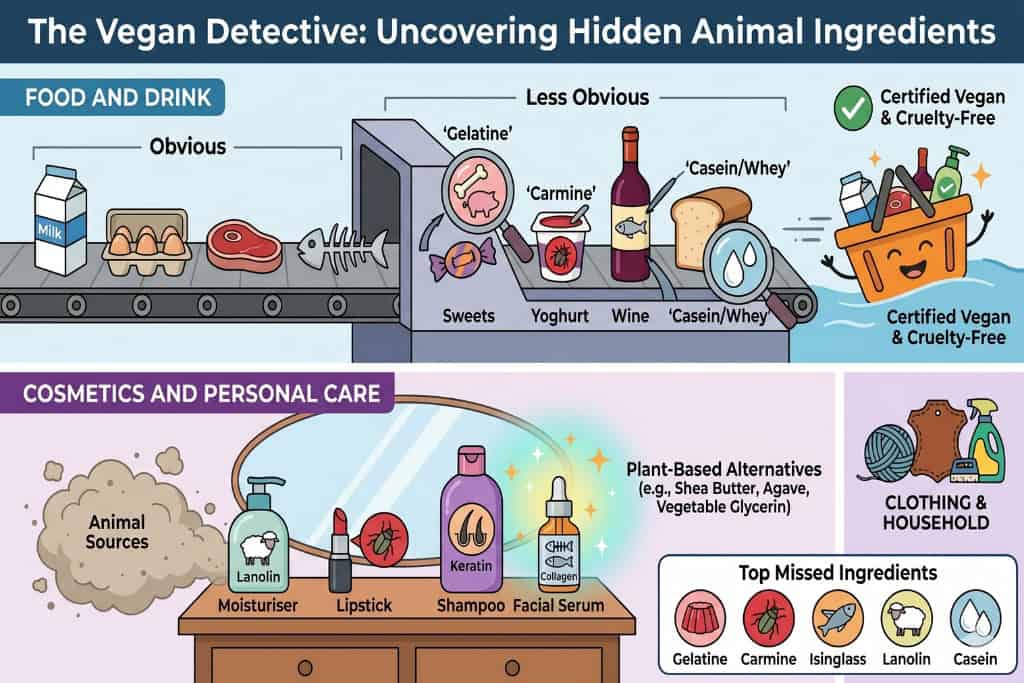
The obvious ones are pretty easy. Milk, eggs, meat, fish — most people know to check for these. It’s the less obvious ones that catch some people out: the gelatine in sweets, the carmine in red-coloured products, the isinglass in wine, the lanolin in moisturiser. This guide covers them.
But where does Vegan Supermarket UK come in? — Well, it’s a really useful online vegan shopping centre that brings together multiple shops, giving you the best chance of finding products that are both vegan and cruelty-free in one place.
Knowing what to look for makes the whole process significantly faster — and a lot less frustrating.
Food and Drink
Gelatine Derived from animal bones, skin, and connective tissue. One of the most widespread hidden animal ingredients. Found in sweets and jellies, yoghurts, marshmallows, chewy sweets, some desserts, and capsule medications. Also used as a fining agent in some wines and beers — though it won’t appear on ingredient lists in those cases.
Casein and whey Milk proteins. Casein is a major protein in dairy milk. Whey is a by-product of cheese production. Both are found in some breads, protein powders, crisps, chocolate, and processed foods. May be listed as “milk protein,” “whey protein,” “casein,” or “sodium caseinate.”
Lactose Milk sugar. Found in some medications, processed foods, certain crisps, and some chocolate products. May not be declared as prominently as casein or whey — check the full ingredient list.
Carmine / E120 / cochineal A red pigment derived from dried and crushed cochineal insects. Used in some fruit juices, sweets, yoghurts, red-coloured drinks, and food products where a red or pink colour is required. Listed as carmine, cochineal, E120, or “natural red 4.”
Isinglass Derived from the dried swim bladders of fish. Used as a fining agent to clarify some beers and wines. Crucially, it is a processing aid rather than an ingredient — it doesn’t remain in the finished product and is not required to be declared on labels. The only way to know is to check with the brand or use a resource like Barnivore.
Albumen / egg white Used in some wines and baked goods as a fining or clarifying agent. May be listed as albumen, egg white, or ovalbumen.
Honey, beeswax, royal jelly, propolis All derived from bees. Honey is found in countless food products — cereals, energy bars, snacks, drinks, condiments. Beeswax (E901) is used as a glazing agent on some confectionery and fruit. Royal jelly and propolis are found in some health supplements.
Shellac / E904 A resin secreted by the lac insect. Used as a glazing agent on some sweets and confectionery, and as a coating on some fruit to make it shiny. Listed as shellac or E904.
E441 Gelatine used as a food additive — the same animal-derived ingredient as gelatine above, listed in its E-number form.
E542 Bone phosphate — derived from animal bones. Used as an anti-caking agent in some powdered foods.
E631 and E635 Flavour enhancers that may be derived from meat or fish. Found in some savoury snacks, instant noodles, and flavoured crisps. May also be synthetic — the only way to confirm is to check with the specific brand.
Lard and suet Animal fats from pigs and cattle. Found in some pastries, pies, and traditional baked goods. Less common in modern products but still worth checking in traditional recipes.
Anchovies Found in some Worcestershire sauces, Caesar dressings, certain pesto products, and some ready meals. Not always obvious from product names.
Cosmetics and Personal Care
Lanolin A waxy substance derived from sheep’s wool. One of the most common animal-derived ingredients in cosmetics. Found in lip balms, moisturisers, hand creams, and some hair conditioners. May be listed as lanolin, wool wax, or wool grease.
Beeswax Used as a thickener and emollient. Found in lip balms, mascaras, eyeshadows, some skincare creams, and hair products. May be listed as beeswax, cera alba, or E901.
Carmine / cochineal / E120 The same insect-derived red pigment used in food. Found in lipsticks, blushers, eyeshadows, and other red or pink cosmetics. May be listed as carmine, cochineal, CI 75470, or natural red 4.
Collagen and elastin Structural proteins usually derived from animal connective tissue, bones, or fish. Found in anti-ageing skincare products, serums, and face masks. Plant-derived versions exist but are less common at the time of writing.
Keratin A protein derived from animal hair, feathers, or hooves. Found in hair treatments, shampoos, conditioners, and nail strengtheners. Plant-based keratin alternatives are available but must be specifically labelled as such.
Squalene A moisturising oil that can be derived from shark liver or from plant sources (typically olive or amaranth). Found in moisturisers, serums, and some sunscreens. Plant-derived squalene is often labelled as “squalane” (note the different spelling) but this isn’t universal — check the source.
Glycerin / glycerol Can be derived from animal fat or from plant sources. Widely used in cosmetics, toiletries, and some food products. Unless labelled as plant-derived or vegetable glycerin, the source is unclear. Many brands now use plant-derived glycerin but they don’t always specify this.
Stearic acid A fatty acid that can be derived from animal fat or from plant sources. Used in many cosmetics and cleaning products. May be listed as stearic acid, stearate, or in compound ingredient names. Unless specified as plant-derived, the source is unclear.
Silk proteins Derived from silkworm cocoons. Found in some haircare products, serums, and makeup. May be listed as silk amino acids, silk protein, or sericin.
Oleic acid A fatty acid that can be animal or plant-derived. Found in cosmetics, soaps, and cleaning products. Check the source with the brand if it matters.
Household and Cleaning Products
Tallow Animal fat derived from cattle or sheep. Used in some soaps and detergents. May be listed as tallow, sodium tallowate, or beef tallow.
Casein Milk protein. Used in some surface cleaners and adhesives.
Lanolin Found in some fabric conditioners as a softening agent.
Beeswax Used in some polishes and wood treatments.
Clothing and Accessories
Leather and suede — animal skins, most commonly from cattle. Wool and cashmere — from sheep and goats. Silk — from silkworms. Down and feathers — from geese and ducks, used in padding. Fur — from various animals. Angora — from rabbits. Shell buttons — made from mollusc shells. Pearl — from oysters.
FAQ
What are the most commonly missed non-vegan ingredients?
Gelatine in sweets and capsules, carmine in red-coloured products, isinglass in wine and beer, casein in processed foods, lanolin in cosmetics, and beeswax in lip products are the ones most frequently overlooked. Knowing these specifically saves the most time.
How do I know if glycerin or stearic acid is plant-derived?
The most reliable way is to check the brand’s website or contact them directly. Some brands specify “vegetable glycerin” or “plant-derived stearic acid” on their packaging or product pages. If no source is stated, the safest approach is to treat it as non vegan unless the brand has a clear vegan policy covering all their ingredients.
Is all gelatine from animals?
Almost all commercially used gelatine is animal-derived — from cattle bones, pig skin, or fish. Plant-based alternatives exist (agar-agar from seaweed, carrageenan, pectin) and are used by some brands, but they’re listed by their own names rather than as gelatine. If a product lists gelatine specifically, treat it as animal-derived.
Are natural flavourings vegan?
Not always. “Natural flavourings” is a broad term that can include both plant-derived and animal-derived sources. Castoreum (from beaver glands), for example, can be used as a natural flavouring. Most natural flavourings are plant-derived, but the term doesn’t guarantee it. If you’re unsure about a specific product, check with the brand.
What’s the difference between vegan and free-from labelling?
Free from labelling (dairy-free, egg-free, gluten-free) is generally designed for people with allergies or intolerances. It only covers the specific allergen stated — a dairy-free product can still contain eggs, honey, gelatine, or other animal-derived ingredients. Vegan labelling covers all animal-derived ingredients. The two are not interchangeable.
Some links on this site may be affiliate links. Product information is for guidance only — always check ingredients, allergens, and suitability before purchase.
This content is for general informational purposes only and is not intended as medical advice. Always check product labels and consult a qualified professional if you have a medical condition or concerns.