
Vegan Household Products UK: What to Look For and Where to Buy

Most people switch to vegan food first and assume the rest of the shopping list can wait. Then they read the back of a cleaning product and realise animal-derived ingredients turn up in places you’d never expect — washing-up liquid, fabric softener, multi-surface sprays.
That’s where Vegan Supermarket UK comes in — an online vegan shopping centre that brings together multiple shops, giving you the best chance of finding products that are both vegan and cruelty-free in one place.
Comparing options across multiple shops takes time, particularly when household product labelling is far less standardised than food.
How People Approach This
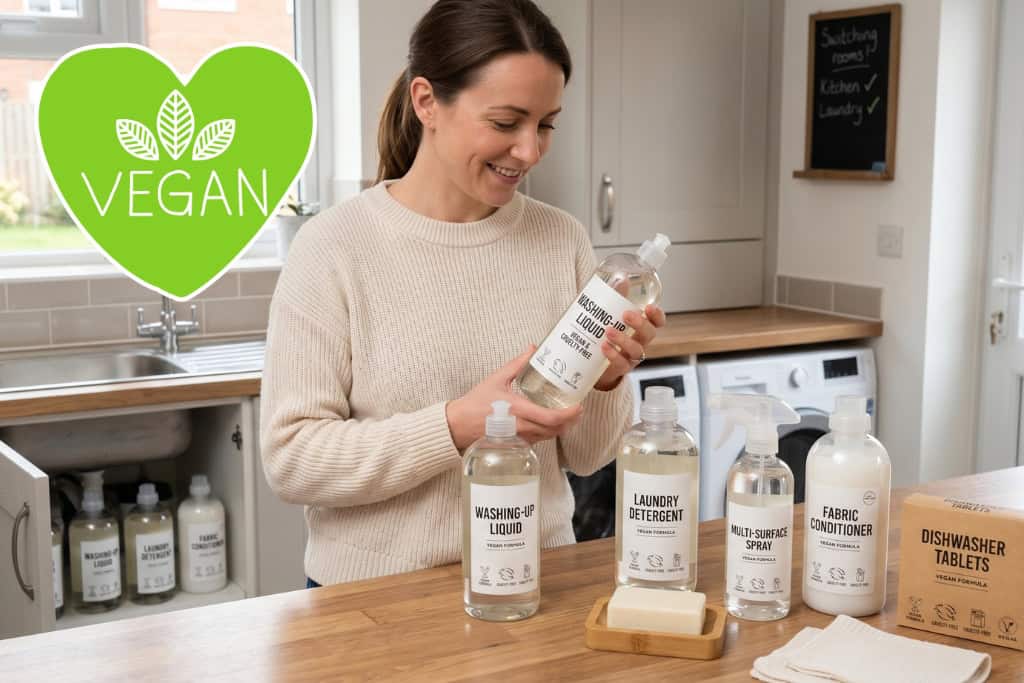
Most people start by replacing the products they use most — washing-up liquid, laundry detergent, surface cleaner. That’s a sensible place to begin. Once those feel sorted, it’s easier to work through the rest of the house category by category rather than trying to do everything all at once.
The research part is where it tends to slow down. Household products don’t have the same labelling conventions as food, and “cruelty-free” in cleaning products specifically refers to animal testing — which is a separate question from whether the formula itself contains animal-derived ingredients. Both matter if you’re looking for genuinely vegan household products.
The good news is that the range has improved considerably, and most common household products now have vegan and cruelty-free alternatives that work just as well.
How to Narrow Your Options
By room or function
It’s easier to work through the house in sections — kitchen cleaning, laundry, bathroom, general surfaces — rather than trying to find everything at once. Each area has its own set of products, and tackling one at a time makes the switch less daunting.
By format
Vegan household products come in a range of formats: concentrated liquids, refillable systems, solid bars, powder, and tablet form. Format affects both convenience and cost per use, so it’s worth thinking about what works for your household before buying.
By budget
Vegan cleaning products range from budget-friendly to premium. Some of the most affordable options are concentrated formulas that work out cheaper per wash than conventional products. Premium options often emphasise packaging, fragrance, or additional ethical credentials. Both sides of the market have great choices.
Where People Actually Buy Vegan Household Products
Dedicated vegan and ethical retailers
Online retailers that specialise in vegan or ethical products are the most reliable source — their ranges are curated, and you’re less likely to have to second-guess labelling. Many offer refill options or subscription delivery, which ticks more boxes.
Health food shops and zero-waste stores
These often carry a good selection of vegan household products, and staff knowledge tends to be good. Zero-waste shops in particular often stock minimal packaging options that are not that easy to find.
Large supermarkets
The mainstream supermarkets have expanded their ethical cleaning ranges, and some vegan household products are now widely stocked. The challenge is that they sit alongside conventional products without clear vegan filtering, so label-checking is still required.
Direct from brand
Buying direct often gives you access to refill programmes, better information about ingredients and testing policies, and sometimes better pricing on larger quantities. It’s worth doing once you’ve found brands that work for you.
What to Check Before Buying
Vegan status
Household products can contain animal-derived ingredients that aren’t obvious. Common ones to watch for include tallow (animal fat, used in some soaps and detergents), casein (milk protein, used in some surface cleaners), lanolin (from sheep’s wool, used in some fabric conditioners), and beeswax (used in some polishes and wood treatments). Always check the full ingredient list.
Cruelty-free status
In household products, cruelty-free means neither the finished product nor its ingredients were tested on animals. This is a separate standard from vegan — a product can be vegan without being cruelty-free. Look for Leaping Bunny certification, which covers both the brand and its ingredient suppliers. Certification logos cost money, and smaller brands don’t always have the budget to go through the formal process. If a brand clearly states they’re vegan and cruelty-free, that’s good enough — you don’t need a logo to prove it.
Ingredients you might not recognise
Some ingredient names don’t make their origin obvious. Stearic acid, for example, can be plant or animal-derived. Oleic acid similarly. If you’re unsure about a specific ingredient, the brand’s own website or a cruelty-free ingredients database is the clearest place to check.
Concentrated vs ready-to-use
Concentration matters for comparing products fairly. A concentrated formula used at a lower dose often works out cheaper and produces less plastic waste than a ready-to-use product. Check usage instructions before assuming one product is more expensive than another.
Product Labelling: What the Terms Actually Mean
Product labelling in household cleaning can be more complicated than it first appears. Here is what to look for.
Vegan A product labelled vegan contains no animal-derived ingredients. The word “vegan” is a trademark owned by The Vegan Society, though many brands use phrases such as “vegan friendly” or “suitable for vegans.” In practice these mean the same thing.
Vegan and vegetarian symbols Packaging sometimes uses symbols such as V, VE, or Vegan. These are not always used consistently — in some cases “Ve” may indicate vegetarian rather than vegan. Vegetarian products may still contain milk, eggs, or honey. It is worth checking that the product clearly states vegan rather than vegetarian.
“May contain” allergy statements These are less common on household products than food, but where they appear they refer to cross-contamination risk, not intentional ingredients.
Cruelty-free Cruelty-free means the finished product and its ingredients were not tested on animals. Some brands display certification logos such as Leaping Bunny or PETA Cruelty-Free. Certification logos cost money, and smaller brands don’t always have the budget to go through the formal process. If a brand clearly states they’re vegan and cruelty-free, that’s good enough — you don’t need a logo to prove it.
China and animal testing Products sold in mainland China have historically been subject to animal testing requirements under certain conditions. Because of this, many organisations consider such products unlikely to meet typical cruelty-free standards.
Marketing claims to watch out for “Natural,” “eco-friendly,” “plant-powered,” and “green” do not mean vegan or cruelty-free. These are marketing terms with no regulated definition in household products. Always check the actual ingredient list and the brand’s stated testing policy.
Simple rule: If a product is not clearly labelled vegan and cruelty-free, treat it as uncertain.
Common Mistakes
Assuming “plant-based” means vegan Plant-based cleaning products may still contain animal-derived ingredients alongside plant-derived ones. The term has no regulated definition in household products. Always check for explicit vegan labelling rather than inferring from “plant-based” or “natural” claims.
Overlooking fabric conditioner and laundry products Fabric conditioners in particular have historically contained animal-derived softening agents. It’s one of the categories people most often overlook when switching to vegan household products. Check it specifically rather than assuming laundry products are fine.
Judging by packaging Recyclable packaging, minimal design, and earthy branding don’t indicate vegan or cruelty-free status. Some of the most ethical-looking products don’t meet either standard, and some straightforwardly packaged ones do. Go by the label, not the look.
Not checking cleaning products sold as “refills” Refill products from a brand you trust are usually fine, but generic refill station products — where you fill a container from a bulk dispenser — aren’t always labelled clearly. If you can’t verify the product, treat it as uncertain.
Forgetting products that aren’t obviously “cleaning” Candles, air fresheners, dishwasher salt, washing machine cleaners, drain unblockers — these are all household products that may contain animal-derived ingredients or have been tested on animals. The switch to vegan and cruelty free household products covers a bigger range than just surface sprays and detergents.
FAQ
Do vegan household products actually clean as well as conventional ones?
For most everyday cleaning tasks, yes. Formulations have improved significantly, and many vegan cleaning products perform on a par with conventional equivalents. Some people find concentrated or specialist formulas work better than mainstream products for specific jobs. It’s worth trying a few to find what works for your household.
Are vegan cleaning products more expensive?
Not necessarily. Budget-friendly vegan options exist across most categories, and concentrated formulas often work out cheaper per use than conventional ready-to-use products. Premium vegan brands do cost more, but they’re not the only option.
What’s the difference between vegan and cruelty-free in household products?
Vegan means the product contains no animal-derived ingredients. Cruelty-free means neither the product nor its ingredients were tested on animals. A product can be one without being the other. If both matter to you — and for most people switching to vegan household products, they do — check both separately.
Is Leaping Bunny certification relevant for household products?
Yes. Leaping Bunny is one of the most rigorous cruelty-free certifications and covers household cleaning products as well as cosmetics. It certifies both the finished product and the ingredient supply chain. It’s a reliable signal, though its absence doesn’t automatically mean a product has been tested on animals — smaller brands may simply not have pursued certification.
Can I find vegan versions of all common household products?
For most categories, yes — washing-up liquid, laundry detergent, fabric conditioner, surface cleaners, bathroom cleaners, and dishwasher products all have vegan alternatives. Some more specialist products (certain wood treatments, pest control products, some drain cleaners) can be harder to find in fully vegan form, but options exist if you look.
Some links on this site may be affiliate links. Product information is for guidance only — always check ingredients, allergens, and suitability before purchase.
This content is for general informational purposes only and is not intended as medical advice. Always check product labels and consult a qualified professional if you have a medical condition or concerns.


