

Wills Vegan Shoes vs Po-Zu: How to Compare Any Two Vegan Shoe Brands

You’ve narrowed it down to two vegan shoe brands and now you’re stuck. Both look good, both claim to be ethical — but their materials, price points, styles, and sustainability approaches are different, and it’s not always obvious which criteria should matter most to you.
That’s where Vegan Supermarket UK comes in — it’s an online vegan shopping centre that brings together multiple shops, giving you the best chance of finding products that are both vegan and cruelty-free in one place. Comparing options across multiple brand websites takes time, particularly when each one presents its credentials differently — having them in one place makes the decision considerably easier.
How People Shop
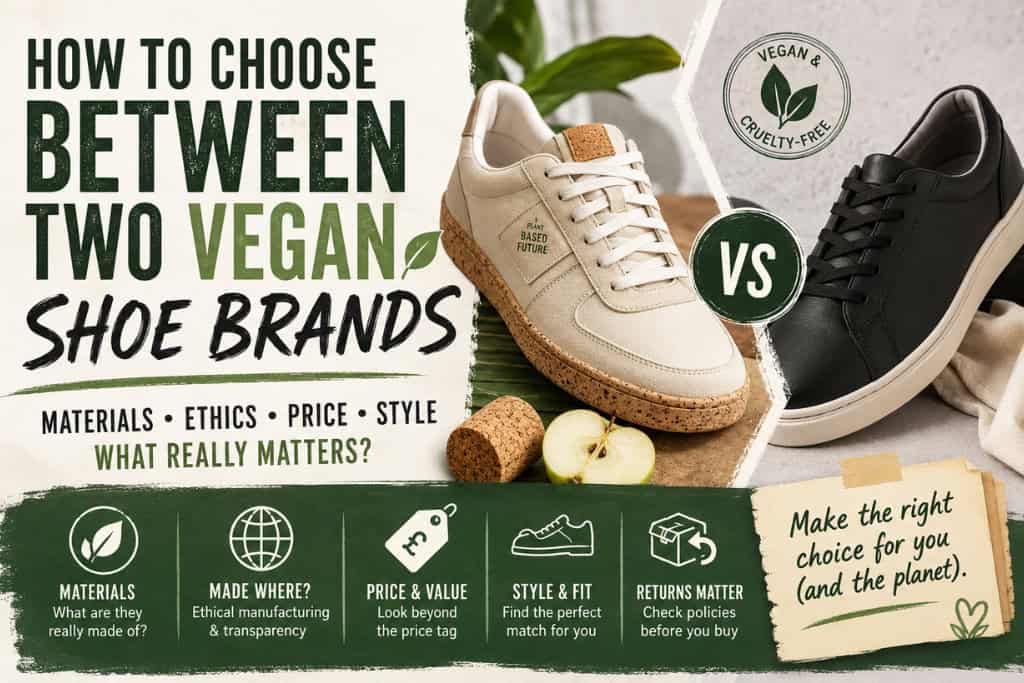
Most people comparing two cruelty-free shoe brands start with a side-by-side look at price and style — which is a reasonable starting point, but misses some of the more meaningful differences. Two brands can both be fully vegan and still differ significantly in their materials philosophy, where their shoes are made, their environmental impact, and how transparent they are about their supply chain.
The most useful comparisons go beyond the surface. Once you’ve confirmed both brands meet your baseline — fully vegan, cruelty-free, the styles you need — the decision usually comes down to materials, manufacturing location, price-to-quality ratio, and personal values around sustainability.
How to Narrow Your Options
By materials philosophy
This is often the biggest real-world difference between specialist vegan footwear brands. Some prioritise plant-based and natural materials — cork, Piñatex, apple leather, natural latex, organic cotton — with a strong sustainability focus alongside the vegan credentials. Others focus on high-quality European-made vegan leather in classic styles, prioritising craft and longevity over material innovation. Neither approach is wrong — it depends on what matters more to you.
By style range
Some ethical shoe brands focus on a narrow range of styles done really well. Others offer a broader catalogue across occasions. Check whether the brand covers the styles you actually want before getting drawn into comparing credentials — a brand with impeccable ethics but no shoes in your required style isn’t the right choice for you right now.
By manufacturing location and transparency
Where a shoe is made matters both ethically and in terms of quality. European manufacture — particularly Portugal and Italy — generally indicates strong labour standards and craft tradition. Some brands manufacture in Asia with equally strong ethical oversight and transparency, but it’s worth checking what information each brand publishes about their factories and workers. Transparency is itself a signal of trustworthiness.
By price and value
Price alone is not a good guide when comparing vegan shoe companies. A higher price can tend to reflect better materials, European manufacture, smaller production runs, or simply a premium brand positioning. Look at what you’re getting for the money — materials quality, construction method, where it’s made — rather than treating a higher price as automatically meaning better value.
Where People Actually Buy
Buying direct from the brand’s own website gives you the most complete information about materials and supply chain, and often the widest range of styles. It also means you’re dealing with the brand’s own customer service if anything goes wrong.
Curated vegan retailers and ethical fashion marketplaces are useful for side-by-side browsing — you can compare options from multiple sustainable footwear brands without jumping between different sites, and you can trust that the vegan credentials have already been checked. General retailers occasionally carry individual styles from specialist vegan brands, but the range is usually limited and the vegan status isn’t always clearly confirmed.
What to Check Before Buying
Full vegan status across all products
Both brands being broadly described as vegan doesn’t guarantee every product in their range is fully animal-free across upper, lining, insole, and adhesive. Check at product level, not just brand level — particularly if a brand has transitioned to vegan over time and still carries some older stock.
Cruelty-free status
Vegan and cruelty-free are distinct. A shoe can be made from animal-free materials but still involve animal testing somewhere in the production process, though this is uncommon in footwear. Check each brand’s stated policy rather than assuming.
Returns policy
When buying vegan leather shoes online without being able to try them first, a clear and generous returns policy matters. Check this before buying, especially when spending over a hundred quid on a pair!
Common Mistakes
Assuming the more expensive brand is automatically better.
Price in the specialist vegan shoe market reflects a range of factors — materials, manufacturing location, brand size, and production volumes — that don’t necessarily relate to quality. A smaller brand with higher production costs per unit may charge more than a larger brand with better economies of scale, without that reflecting any difference in the shoe quality itself.
Choosing based on brand values rather than the specific product.
A brand can have excellent ethics but still produce a particular style that doesn’t quite suit your particular foot shape, usage. Brand-level research is important.
Not checking whether both brands ship to your location with reasonable delivery costs.
Some specialist vegan footwear brands are based overseas and shipping costs can significantly affect the real price of the shoe. Factor this in before deciding.
Label Education: Clothing & Accessories
When comparing vegan shoe brands, the same material checks apply regardless of how strong either brand’s ethical reputation is.
What makes a shoe non-vegan
Animal-derived materials to watch for include leather and suede uppers or linings, wool insoles or lining, and animal-based adhesives. Even brands with strong vegan credentials can have individual products that include non-vegan components — always check at product level.
Vegan alternatives
Fully vegan shoes use plant-based or synthetic uppers, synthetic or organic fabric linings, cork or synthetic insoles, and synthetic adhesives. Higher-quality options use innovative plant-based materials — Piñatex, apple leather, cork, natural latex — which tend to perform better over time than basic PU.
What to check on the label
UK footwear labels must state materials for the upper, lining, and outer sole. Check all three. If any component is listed as leather or left unspecified, contact the retailer for clarification before buying.
Simple rule: If the full materials list isn’t clearly animal-free across every component, treat it as uncertain.
FAQ
How do I decide between two vegan shoe brands when both seem equally ethical?
Once you’ve confirmed both meet your baseline — fully vegan, cruelty-free, the right styles — narrow by what matters most to you personally: materials philosophy, manufacturing location, price, or style range. There’s rarely a single objectively correct answer; it comes down to your own priorities.
Does where a shoe is made actually matter for quality?
It can, yes. European manufacture — particularly Portugal and Italy — has a long tradition of skilled shoemaking that often shows in the construction quality. That said, some brands manufacturing in Asia with transparent, ethical supply chains produce excellent shoes. Where it’s made is one signal among several, not a definitive quality guarantee.
Is a brand that focuses on natural materials better than one using high-quality synthetic vegan leather?
Not necessarily — it’s a different philosophy rather than a better or worse one. Natural and plant-based materials tend to have stronger environmental credentials. High-quality synthetic vegan leather can offer better durability and water resistance. The right choice depends on whether your priority is environmental impact, longevity, or style.
Can I trust a brand’s vegan claims without certification?
Generally yes, particularly for established specialist vegan brands. Formal certification from bodies like The Vegan Society costs money, and smaller brands don’t always pursue it even when their products genuinely qualify. What matters more is whether the brand publishes clear, detailed information about their materials and is responsive to direct questions about specific products.
What if one brand has better styles but the other has stronger ethics?
That’s a genuine tension and there’s no universal answer. The most practical approach is to check whether the brand with better styles is actually problematic on ethics, or just less publicly vocal about them — those are very different situations. If both brands are genuinely ethical and vegan, choosing based on style is a perfectly reasonable decision.