
Online Vegan Shopping UK: How to Buy Vegan Products Without the Usual Frustration

Shopping for vegan products online sounds like it should be straightforward. In reality it often means opening six tabs, reading ingredient lists on images too small to zoom into properly, and still not being completely sure what you’ve ordered is actually vegan.
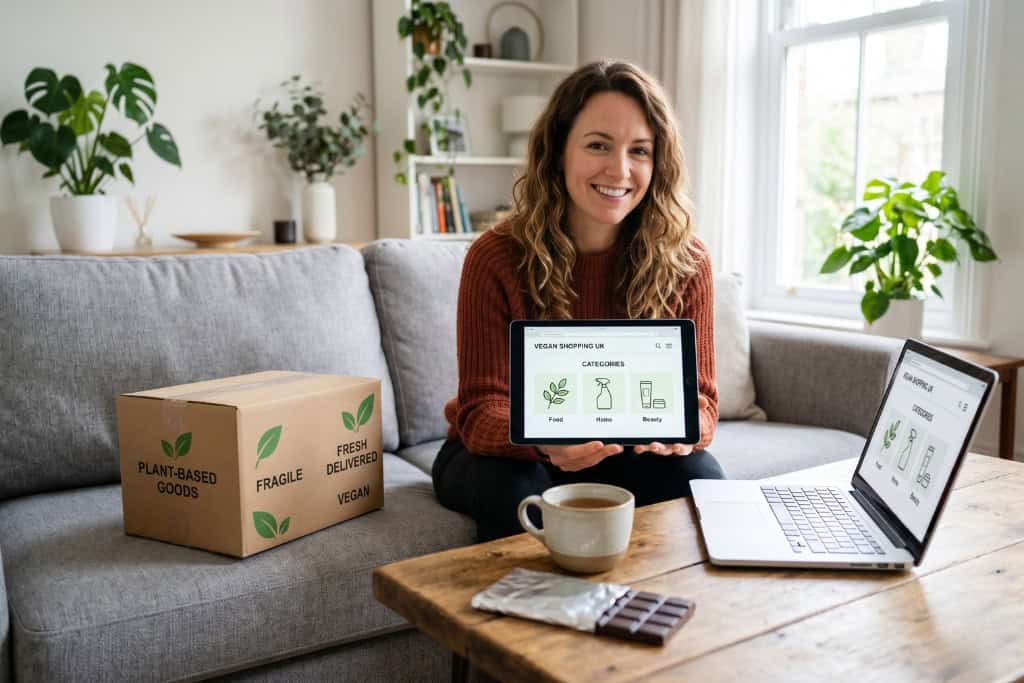
That’s where Vegan Supermarket UK comes in — an online vegan shopping centre that brings together multiple shops, giving you the best chance of finding products that are both vegan and cruelty-free in one place.
Comparing options across multiple shops takes time, particularly when online labelling is often less clear than what you’d find on a physical product in a shop.
How People Approach This
Most people start by adding vegan products to their existing online shop — the supermarket they already use, or a retailer they’re familiar with. That works for basics, but it puts the verification burden entirely on the shopper. You’re filtering from a catalogue built for everyone, not just vegan buyers.
The shift to dedicated online vegan shopping tends to happen once people get frustrated enough with that process. A retailer that has done the checking for you, grouped products by category, and only stocks things that actually meet the standard is a different experience from hunting through a general retailer’s search results.
Most people end up settling into a pattern: a mainstream shop for staples, a specialist vegan source for everything else, and a clear sense of which type of product to get from where.
How to Narrow Your Options
By what you’re buying
Online vegan shopping covers food, personal care, household products, clothing, and gifts. The best source for each category varies — mainstream retailers handle food staples well; specialist vegan sites handle the rest more reliably. Being clear on what you’re looking for before you start helps you land in the right place quickly.
By how you want to shop
Some people prefer to browse and discover. Others want to find a specific product and buy it as quickly as possible. A curated vegan platform suits both — it’s browsable by category for discovery, and searchable by product for directness. General retailers require more filtering effort to get to the same result.
By delivery needs
Online shopping is only useful if what you want can be delivered – and fast!. Check delivery coverage, minimum orders, and lead times before building a basket — particularly for specialist retailers, which sometimes have longer shipping windows than the more well-known stores.
Where People Actually Shop for Vegan Products Online
Dedicated vegan online retailers
These offer the most reliable experience for online vegan shopping. Ranges are curated, and you’re not wading through non-vegan results. Many cover multiple categories in a single order.
Multi-retailer vegan platforms
These bring together products from multiple vegan-friendly shops, which is useful when a single retailer doesn’t carry everything you need. The browsing experience is closer to a department store than a specialist shop.
Mainstream supermarket websites
Good for vegan staples delivered alongside the rest of your weekly shop. Vegan filtering is improving but still not infallible — products are sometimes miscategorised, and you’re relying on brands to have labelled correctly. Not suitable as a sole vegan shopping source.
Brand websites
Buying direct gives you the fullest range, the clearest product information, and often the best prices on that brand’s products specifically. Most practical once you’ve identified brands you buy regularly.
Online marketplaces
Wide range, but variable reliability. Vegan status is self-declared by sellers, quality control varies, and product listings aren’t always accurate. Useful for finding specific items but not a substitute for curated vegan retail.
What to Check Before Buying
Vegan status on product pages
Online product pages vary in how clearly they state vegan status. Look for explicit labelling — “suitable for vegans,” “vegan friendly,” or the Vegan Society trademark. If a product page doesn’t confirm vegan status, don’t assume — either check the brand’s website directly or treat it as uncertain.
Cruelty-free status for personal care and household products
Vegan and cruelty-free are separate standards. A product can be vegan without being cruelty-free. For cosmetics and cleaning products especially, check both. Look for Leaping Bunny or PETA Cruelty-Free certification. Certification logos cost money, and smaller brands don’t always have the budget to go through the formal process. If a brand clearly states they’re vegan and cruelty-free, that’s good enough — you don’t need a logo to prove it.
Product images vs actual labels
Online product images don’t always show the current version of a product. Formulations change, and the image on a product page may be out of date. If vegan status matters to you — and it does — check the brand’s website for current ingredient information rather than relying solely on product photos.
Reviews and seller ratings on marketplaces
When buying from marketplaces, check seller ratings and read recent reviews. Counterfeit or mislabelled products are more common on open marketplaces than on dedicated vegan retailers or brand sites.
Product Labelling: What the Terms Actually Mean
Product labelling can sometimes be confusing when shopping online. Here is a short guide to the terms you will most commonly see.
Vegan A product labelled vegan contains no animal-derived ingredients. The word “vegan” is a trademark owned by The Vegan Society, though many brands use phrases such as “vegan friendly” or “suitable for vegans.” In practice these mean the same thing.
Vegan and vegetarian symbols Packaging sometimes uses symbols such as V, VE, or Vegan. These are not always used consistently — in some cases “Ve” may indicate vegetarian rather than vegan. Vegetarian products may still contain milk, eggs, or honey. It is worth checking that the product clearly states vegan rather than vegetarian.
“May contain” allergy statements Some vegan products may still include warnings such as “may contain milk” or “may contain egg” due to shared manufacturing environments. This does not mean these ingredients are intentionally included.
Cruelty-free Cruelty-free means the finished product and its ingredients were not tested on animals. Some brands display certification logos such as Leaping Bunny or PETA Cruelty-Free. Certification logos cost money, and smaller brands don’t always have the budget to go through the formal process. If a brand clearly states they’re vegan and cruelty-free, that’s good enough — you don’t need a logo to prove it.
China and animal testing Products sold in mainland China have historically been subject to animal testing requirements under certain conditions. Because of this, many organisations consider such products unlikely to meet typical cruelty-free standards.
Marketing claims to watch out for Phrases such as “natural,” “eco-friendly,” “plant-powered,” or “clean” do not guarantee that a product is vegan or cruelty-free.
Simple rule: If a product is not clearly labelled vegan and cruelty-free, treat it as uncertain.
Common Mistakes
Using a mainstream retailer’s vegan filter and trusting it completely Vegan filters on general retailers depend on brands correctly tagging their products. Mistakes happen — products appear in vegan filters that aren’t vegan, and vegan products sometimes don’t appear because they haven’t been tagged. A curated vegan retailer is more reliable.
Treating “plant-based” as equivalent to vegan Plant-based is a marketing term with no regulated definition. It usually refers to diet and doesn’t always mean entirely free of animal products. Always look for the word “vegan” specifically.
Not checking whether the retailer delivers to your postcode Some specialist vegan retailers — particularly those handling chilled or perishable products — have restricted delivery coverage. Check before you spend time filling a basket.
Ordering from multiple retailers and paying delivery on each Online vegan shopping spread across several sites adds up in delivery costs. Using a platform that aggregates multiple retailers, or planning fewer larger orders per retailer, keeps this under control.
Assuming a product you’ve bought before is still the same Formulations change without much notice. A product that was vegan when you first ordered it may have been reformulated since. Worth checking periodically on anything you buy regularly.
FAQ
Is online the best way to buy vegan products in the UK?
For range and convenience, yes — the widest selection of vegan products is available online, and dedicated vegan retailers make the verification process significantly easier than shopping in person at a general retailer. In-person shopping has the advantage of being able to physically read labels, but the product range is more limited outside major cities.
Are vegan products more expensive when bought online?
Not necessarily. Some specialist products cost more than mainstream equivalents, but many everyday vegan staples are competitively priced online. Concentrated or bulk-buy options can be cheaper per use than the same product bought in a supermarket. Delivery costs are the main variable — worth factoring in when comparing prices.
How do I avoid non-vegan substitutions in an online order?
Check the retailer’s substitution policy before ordering. Some dedicated vegan retailers don’t substitute at all. If you’re ordering from a mainstream retailer with a substitution policy, you can usually opt out of substitutions for specific items or set substitution preferences in your account.
Can I find vegan versions of all my usual products online?
For most everyday product categories, yes. Vegan food, personal care, household cleaning, and lifestyle products are all widely available online. Some more specialist items take more searching, but the range is broader online than in any physical shop.
What’s the most reliable way to verify a product is vegan when buying online?
Look for explicit vegan labelling — “suitable for vegans,” “vegan friendly,” or the Vegan Society trademark. If you can’t confirm vegan status from the brand’s own information, treat it as uncertain.
Some links on this site may be affiliate links. Product information is for guidance only — always check ingredients, allergens, and suitability before purchase.
This content is for general informational purposes only and is not intended as medical advice. Always check product labels and consult a qualified professional if you have a medical condition or concerns.