
Vegan vs Plant-Based UK: What’s the Difference and Why It Matters When You Shop

Plant-based and vegan are used interchangeably on packaging, menus, and product listings across the UK. They don’t mean the same thing. If you’re shopping for products that genuinely avoid all animal ingredients, understanding the difference saves you from buying things that don’t actually meet your needs.
That’s where Vegan Supermarket UK comes in — it’s an online vegan shopping centre that brings together multiple shops, giving you the best chance of finding products that are both vegan and cruelty-free in one place.
Comparing options across multiple shops takes time, particularly when labelling is inconsistent and “plant-based” is used as loosely as any other marketing term.
How People Approach This
Most people encounter the vegan vs plant-based question when they pick up a product labelled “plant-based” and wonder whether it meets a vegan standard. The answer is often: not necessarily.
The confusion exists because “plant-based” entered mainstream food and product marketing without a regulated definition, while “vegan” has a clearer — though still not legally enforced — meaning backed by The Vegan Society trademark. Brands have taken advantage of the ambiguity, using “plant-based” to appeal to a broad audience without committing to a strict no-animal-ingredients standard.
Understanding what each term actually means — and what it doesn’t — is the foundation of reliable vegan shopping.
What “Vegan” Actually Means
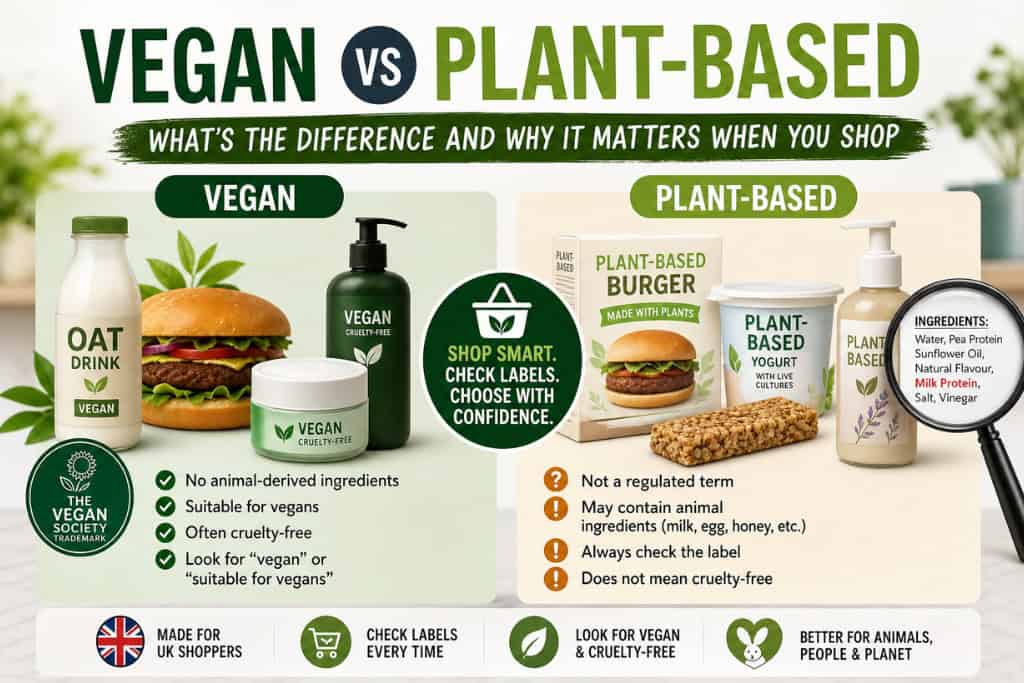
Vegan, in the context of products, means no animal-derived ingredients at any point in the product. This applies to food, cosmetics, household products, and clothing. The Vegan Society owns “vegan” as a trademark, and products that carry their logo have been verified against their standard.
In practice, many brands use phrases like “suitable for vegans” or “vegan friendly” without formal certification. These are generally reliable as long as the brand has applied the standard consistently — but they’re self-declared rather than independently verified.
For most people applying a vegan standard, a product labelled vegan or “suitable for vegans” is the target. It’s not a legally enforced standard, but it’s a meaningful one with a broadly understood definition.
What “Plant-Based” Actually Means
Plant-based has no regulated definition in the UK. It is a marketing term that can mean different things depending on who’s using it.
In food, it usually means the product is made primarily or entirely from plants — but “primarily” is doing a lot of work there. A product can be labelled plant-based and still contain milk, eggs, honey, or other animal-derived ingredients in smaller quantities. Some brands use it to mean entirely free of animal ingredients; others use it to mean “we’ve reduced the animal content” or simply “this is aimed at health-conscious consumers.”
In cosmetics and household products, plant-based typically refers to the origin of key ingredients — plant-derived rather than petrochemical. It says nothing about whether animal-derived ingredients are also present.
In clothing, plant-based sometimes refers to natural fibres as opposed to synthetic ones — which would include cotton and linen but also wool and silk, neither of which is vegan.
The short version: plant-based tells you something about what’s in a product. It doesn’t tell you that animal ingredients are absent.
How to Narrow Your Options
If you’re shopping for vegan products
Look for the word “vegan” specifically, either as a label, the Vegan Society trademark, or an explicit “suitable for vegans” statement. Don’t rely on “plant-based” as a proxy for vegan — it isn’t one.
If you’re shopping plant-based for health reasons
The vegan standard is stricter than most plant-based definitions and is a reliable starting point even if your motivation is health rather than ethics. A product that is vegan will also be plant-based in any meaningful sense, but not vice versa.
If you’re in a mixed household
Understanding the difference matters particularly in mixed households where some people are vegan and others are not. A product labelled plant-based may be suitable for the non-vegan members of the household but not meet the standard for the vegan ones. Check labels individually rather than assuming plant-based = vegan.
Where the Distinction Matters Most
Food and drink
This is where the plant-based label is most widely used and most likely to mislead. Plant-based burgers, plant-based milk alternatives, plant-based ready meals — all of these may or may not be vegan depending on the brand and formulation. Always check for a vegan label or “suitable for vegans” statement rather than relying on “plant-based.”
Cosmetics and personal care
“Plant-based” in cosmetics usually refers to the base ingredients. It doesn’t mean the product is free of animal-derived ingredients like beeswax, lanolin, carmine, or collagen. Check for explicit vegan labelling and, separately, for cruelty-free certification.
Household products
As with cosmetics, plant-based cleaning products may still contain animal-derived surfactants or other animal-derived ingredients. A vegan label is the more reliable standard.
Clothing
Plant-based fibres include cotton, linen, hemp, and bamboo — all vegan. But plant-based as a descriptor for clothing doesn’t exclude wool or silk, which come from animals. Always check materials specifically rather than inferring from plant-based branding.
Product Labelling: What the Terms Actually Mean
Product labelling can sometimes be confusing. Here is a short guide to the terms you will most commonly see.
Vegan A product labelled vegan contains no animal-derived ingredients. The word “vegan” is a trademark owned by The Vegan Society, though many brands use phrases such as “vegan friendly” or “suitable for vegans.” In practice these mean the same thing.
Plant-based Not a regulated term. Generally means the product is made primarily or entirely from plant-derived ingredients, but does not guarantee the absence of animal-derived ingredients. Always check for explicit vegan labelling if no animal ingredients is your standard.
Vegan and vegetarian symbols Packaging sometimes uses symbols such as V, VE, or Vegan. These are not always used consistently — in some cases “Ve” may indicate vegetarian rather than vegan. Vegetarian products may still contain milk, eggs, or honey. It is worth checking that the product clearly states vegan rather than vegetarian.
“May contain” allergy statements Some vegan products may still include warnings such as “may contain milk” or “may contain egg” due to shared manufacturing environments. This does not mean these ingredients are intentionally included.
Cruelty-free Cruelty-free means the finished product and its ingredients were not tested on animals. This is a separate standard from vegan. Some brands display certification logos such as Leaping Bunny or PETA Cruelty-Free. Certification logos cost money, and smaller brands don’t always have the budget to go through the formal process. If a brand clearly states they’re vegan and cruelty-free, that’s good enough — you don’t need a logo to prove it.
Marketing claims to watch out for “Natural,” “eco-friendly,” “clean,” and “sustainable” do not mean vegan or plant-based in any verified sense. These terms carry no regulated definition in product marketing.
Simple rule: If a product is not clearly labelled vegan and cruelty-free, treat it as uncertain.
Common Mistakes
Using plant-based as a shortcut for vegan The most common mistake. Plant-based does not mean vegan. A product can be plant-based and contain milk, eggs, honey, or other animal-derived ingredients. Always look for explicit vegan labelling.
Assuming plant-based cosmetics are vegan In cosmetics, plant-based refers to ingredient origin — it says nothing about whether animal-derived ingredients are also present. Beeswax, lanolin, and carmine are all commonly found in products marketed as plant-based or natural.
Treating the terms as interchangeable in mixed households If one person in a household is vegan and another is eating plant-based for health reasons, the standards they’re applying may be different. A product that works for one may not work for the other. It’s worth being specific about which standard you’re shopping to.
Not checking reformulated products Some products that were previously vegan have been reformulated using plant-based marketing language while introducing animal-derived ingredients. If a product you’ve bought before has changed its labelling from “vegan” to “plant-based,” check the ingredient list again.
Assuming restaurants and cafes use the terms consistently In food service, plant-based and vegan are used interchangeably by some establishments and differently by others. Always confirm with staff if vegan status matters to you — don’t rely on menu labelling alone.
FAQ
Is plant-based food vegan?
Not automatically. Plant-based food is made primarily from plants, but that doesn’t guarantee the absence of all animal-derived ingredients. Some plant-based products are vegan; others contain small amounts of milk, egg, or honey. Check for explicit vegan labelling rather than assuming plant-based means vegan.
Why do brands use “plant-based” instead of “vegan”?
Several reasons. Plant-based has broader appeal — it attracts health-conscious consumers who aren’t vegan, flexitarians, and people reducing animal products without eliminating them. It also carries no formal standard, which gives brands more flexibility. Vegan is a more specific claim that commits the brand to a stricter standard.
Is “suitable for vegans” the same as vegan?
In practice, yes — it means the product contains no animal-derived ingredients and is produced in a way considered acceptable to vegans. It’s self-declared rather than independently certified, but it’s a meaningful and reasonably reliable claim.
Does plant-based mean cruelty-free?
No. Plant-based refers to ingredients; cruelty-free refers to animal testing. A plant-based product could still have been tested on animals. If cruelty-free matters to you — and for most people applying a vegan standard, it does — check that separately.
Which term should I look for when shopping vegan?
Look for “vegan,” “suitable for vegans,” or “vegan friendly” — ideally with a Vegan Society trademark or equivalent certification. “Plant-based” is a useful signal that a product may be vegan, but always confirm with the label before buying.