
How to Repair Vegan Leather Shoes (And When It’s Time to Replace Them)

Even vegan leather shoes can scuff, peel, crack, or come unglued eventually — and when they do, most repair guides you find online are written for animal leather, which behaves quite differently. Trying the wrong fix on the wrong material can make things a whole lot worse.
That’s where Vegan Supermarket UK comes in — it’s an online vegan shopping centre that brings together multiple shops, giving you the best chance of finding products that are both vegan and cruelty-free in one place.
If repair isn’t on the cards, finding a fully verified vegan replacement without trawling multiple sites is much faster when you look in one place. And comparing options across multiple shops takes time, particularly when labelling varies so much between retailers.
How People Shop
Most people search for vegan leather repair advice and land on guides written for genuine leather — only to find the recommended products contain animal-derived ingredients or simply don’t work reliably on synthetic materials. The key issue is that faux leather repair requires products specifically formulated for PU, PVC, or plant-based materials rather than traditional leather conditioners or waxes.
The right approach also depends on which type of vegan leather you’re dealing with. PU (polyurethane) leather, PVC, microfibre leather, and plant-based leathers like Piñatex or apple leather all have different properties and respond differently to repair attempts. Knowing your material before you start saves a lot of heartache, effort and money.
How to Narrow Your Options
By type of damage
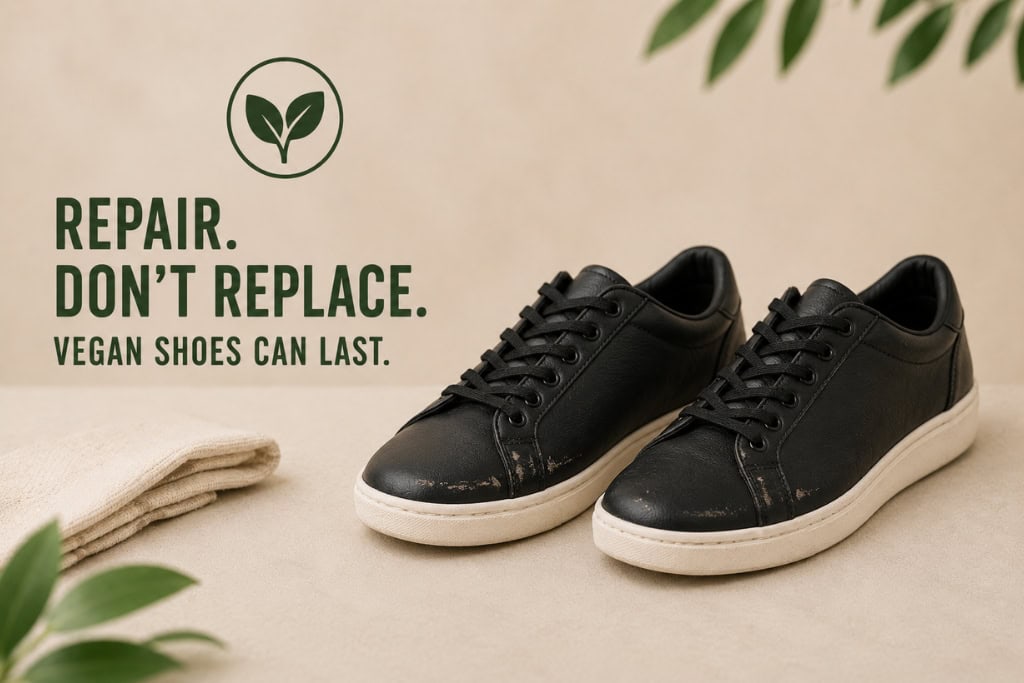
Surface scuffs and minor scratches are the easiest to fix — a colour-matched vegan leather repair cream or flexible filler will often restore the appearance with not too much effort. Peeling and delamination, where the surface coating separates from the base material, is a bit harder to fix permanently and often signals the shoe is nearing the end of its life. Sole separation is a separate issue entirely — it’s a glue failure rather than a material failure, and is frequently repairable regardless of the upper material.
By material type
PU leather is the most common material in everyday vegan shoes and responds reasonably well to flexible filler-based synthetic leather repair products. PVC is less flexible and can crack further if the wrong product is used. Higher-end plant-based leathers like Piñatex tend to be more durable and less prone to peeling, but fewer specialist repair products exist for them. (Maybe it’s because they are so damn good!) — contact the original shop for advice if you’re unsure what you’re working with.
By repair method
For cruelty-free shoe repair, options range from DIY repair kits — flexible filler, colour-matched dye, and adhesive — through to professional cobblers. Not all cobblers are familiar with synthetic materials, so it’s worth ringing them up and asking specifically whether they have experience with vegan leather before handing your shoes over.
Where People Actually Buy Repair Products
Specialist vegan and cruelty-free product retailers are the most reliable source for animal-free shoe care products, as they’ve already confirmed no animal-derived ingredients are used. General shoe care ranges from hardware or shoe shops may contain animal-derived ingredients — leather conditioners in particular often contain lanolin or beeswax.
Online retailers carry a wide range of flexible filler and colour-repair kits suitable for synthetic leather. Look specifically for products marketed for vinyl, PU leather, or faux leather rather than “leather” generically — these are formulated for the right material and are considerably more likely to be animal-free.
What to Check Before Starting a Repair
The repair product’s ingredients
Even products labelled “leather repair” can contain animal-derived ingredients — lanolin, beeswax, and animal-based glues are common in traditional shoe care. Check the ingredients list before buying, or purchase from a retailer that confirms vegan status across their range.
Whether the damage is actually repairable
Surface scuffs on synthetic leather shoes can usually be improved significantly with the right products. Peeling that covers a large area, or where the base material itself has degraded, is very difficult to repair durably — patched areas tend to peel again within weeks. Be realistic about whether repair is genuinely worth attempting before spending money on products. You don’t want your beautiful shoes to look crappy, do you.
Sole adhesive vegan status
If you’re re-gluing a sole, most modern synthetic contact adhesives are animal-free — but check if you’re buying a specialist cobbler’s adhesive, as some traditional formulations are animal-derived.
Common Mistakes
Using products designed for animal leather.
Traditional leather conditioners, creams, and polishes are formulated for animal hide — they don’t penetrate or condition synthetic materials in the same way, and some can leave a residue or cause discolouration on PU or PVC surfaces.
Applying filler over peeling vegan leather without addressing the root cause.
Peeling in PU leather is usually a sign the bonding between the surface coating and the backing has broken down. Filling over it without cleaning and priming the surface first means the repair could lift again quickly.
Not testing on a hidden area first.
Any repair product — filler, dye, or adhesive — should be tested on an inconspicuous part of the shoe before applying to a visible area. Colour matching in particular can be tricky, and getting it wrong on the toe cap is a lot worse than getting it wrong on the inside of the heel.
Label Education
When buying repair products for vegan leather shoes, the same principle applies as when buying the shoes themselves — check that no animal-derived ingredients are used anywhere in the product.
What makes a shoe repair product non-vegan
Common animal-derived ingredients in shoe care products include lanolin (from sheep’s wool — found in conditioners and polishes), beeswax (found in many leather creams), animal-based glues (traditionally used in cobblers – Pardon?), and shellac (insect-derived — sometimes used in shoe finishes).
Vegan alternatives
Vegan shoe care and repair products use plant-derived waxes such as carnauba and candelilla, synthetic polymers, and water-based or petroleum-derived adhesives. These are widely available — look for products specifically labelled for faux leather, vinyl, or synthetic materials rather than leather generically.
Simple rule:
If the repair product doesn’t clearly state its ingredients or vegan status, treat it as uncertain and find an alternative.
FAQ
Does anyone even repair shoes nowadays?
Believe it or not, yes! — and it’s having something of a revival. The cost of living squeeze has made repair a more attractive option than replacing, and there’s been a broader cultural shift toward buying less and looking after things better.
For vegan shoes specifically, repair makes particular sense — a well-made pair of vegan leather shoes that’s been resoled or patched can last considerably longer than the throwaway fast fashion alternative. Independent cobblers are still widely available across the UK, and a growing number specifically advertise experience with synthetic and vegan materials.
Can vegan leather shoes be repaired like regular leather shoes?
Not with the same products. Vegan leather — whether PU, PVC, or plant-based — requires repair products formulated for synthetic materials. Traditional leather repair products are designed for animal hide and may not bond correctly or could cause discolouration on synthetic surfaces.
Why is my vegan leather peeling and can it be fixed?
Peeling in PU vegan leather is caused by the surface coating separating from the backing material — a form of delamination that typically happens with age, heat exposure, or heavy use. Minor peeling can often be patched with a flexible filler and colour-matched dye, but extensive peeling across a large area is very difficult to repair durably.
Are shoe repair glues vegan?
Most modern synthetic contact adhesives are vegan, but traditional cobbling adhesives can be animal-derived. If you’re buying a specialist shoe repair adhesive, check the ingredients or contact the manufacturer before using. General-purpose synthetic contact adhesives from hardware shops are usually animal-free.
Can a cobbler repair vegan leather shoes?
Yes, but not all cobblers have experience with synthetic materials. Call ahead and ask specifically whether they work with PU or faux leather — a good cobbler will give you an honest answer. Sole replacement and re-gluing are generally straightforward regardless of upper material; surface repair to PU uppers requires more specialist knowledge.
When should I replace rather than repair?
If the surface coating is peeling extensively, the base material has cracked or disintegrated, or the shoe has lost its structure, repair is unlikely to hold. At that point, finding a fully vegan replacement is the more practical option — and better value than repeated repair attempts on a shoe that has reached the end of its life.
Some links on this page may be affiliate links. Product information is for guidance only — always check materials and suitability before buying. This content is for general informational purposes only and is not intended as advice.